A dog walker’s grim discovery in the ruins of a Victorian mansion has revived talk of a mystery predator on Solihull’s doorstep, though the more mundane explanation may lie with a den of foxes.
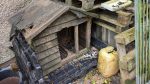
A stroll through woodland barely a mile from Solihull town centre took an unsettling turn last week when a local walker stumbled across the stripped remains of a deer amid the ruins of New Berry Hall, at Ravenshaw.
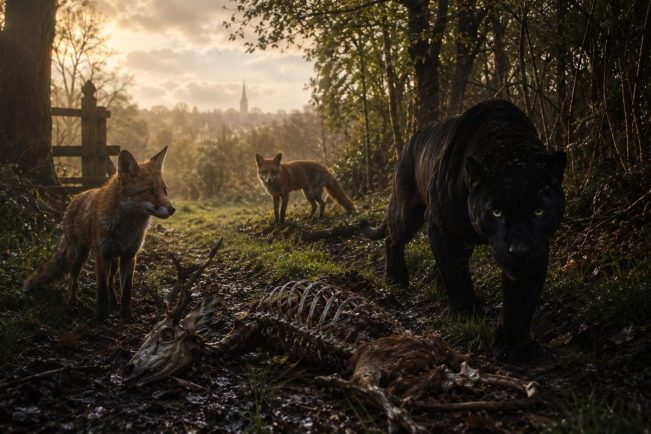
The carcass, later identified as an adult muntjac doe, had been almost entirely consumed.
According to the walker, the hide had been peeled back, yet the ribcage, head and limbs remained attached and largely intact, a pattern he said was consistent with the “known traits of big cat kills.”
He photographed the scene and passed the images to a big cat researcher, who reportedly told him the find pointed to “potential cat consumption.”
It’s a striking claim for an area not typically associated with exotic predators. Solihull sits well south of the Warwickshire and Coventry hotspots more usually linked to Britain’s long-running “phantom big cat” folklore, sightings which, in this region alone, stretch back to a puma-like animal reported near Nuneaton in 1976, through a wave of “Beast of Allesley” reports in 1998, right up to this year’s spate of Binley Woods encounters that has already earned its resident phantom the nickname “the Binley Mega Kitty.”
A grand house reduced to ruins
The setting adds its own layer of intrigue. New Berry Hall was built in the 1870s for Joseph Gillott Jnr, son of the Birmingham pen-nib manufacturer whose fortune funded the sprawling mansion, complete with a tower modelled on Oxford’s Tom Tower and an ornamental lake. The hall stood on the wider Berry Hall estate, not to be confused with the older, half-timbered Berry Hall Farm nearby, which still stands today. After decades of wrangling over planning permission for the green-belt site, the once-grand house fell into disrepair and was eventually demolished in the late 1980s, leaving the atmospheric ruins where the carcass was found.
Why muntjac, and why it matters
Muntjac are Britain’s smallest deer, standing roughly knee-high and typically weighing between 9 and 18kg, not much bigger than a large dog. They’re also not native: the species was introduced from China to Woburn Park in Bedfordshire in the early 1900s, and escapees have since spread across most of England, where they’re now classed as an invasive species.
Crucially, adult muntjac are generally considered too large for Britain’s existing wild predators. Foxes are well documented as taking muntjac fawns, in some areas accounting for around half of fawn deaths, but a fully grown doe would ordinarily be beyond a fox’s capabilities, which is part of what fuelled the walker’s initial big cat theory. He also noted that a scavenged carcass would usually be scattered and untidy, whereas this one appeared, in his words, cleanly picked apart.
The fox explanation
Despite his initial theory, the walker later said he’d since been told a fox den was located close to where the carcass was found, raising the possibility that, whatever killed the deer, foxes (potentially working with other scavengers such as badgers) may have been responsible for the “clinical” state it was left in, rather than a big cat making the kill itself.
Decades of regional lore
Britain has no confirmed breeding population of wild big cats, and no verified carcass, footprint cast or trail-camera image has ever definitively proven one exists. Much of the folklore is thought to trace back to the Dangerous Wild Animals Act 1976, after which it’s rumoured some private owners of exotic cats released their pets into the countryside rather than pay for new licensing requirements. Whatever the origin, sightings across Warwickshire and Coventry have persisted for half a century, taking in local legends such as the Maxstoke Beast, the Pebworth Panther and the Beast of Claverdon, alongside a resurgence of reports from Binley Woods in recent months.
Whether Solihull has now gained its own chapter in that story, or whether the Ravenshaw find turns out to be the work of an opportunistic fox, remains unconfirmed. Wildlife officers generally advise that anyone who spots an unusual animal, or comes across similar remains, should photograph the scene from a safe distance and report it to the relevant authorities rather than approach it.
Solihull Observer has approached Warwickshire Police for comment.