When the fixtures for the 2026 World Cup landed, supporters across Solihull and the wider West Midlands felt that familiar flutter of anticipation.
A tournament spread across three host nations, kick-offs running deep into British evenings, and the prospect of England progress to argue about down the local — it all adds up to a summer of football that few have lived through before.
Pubs along the Stratford Road are already pencilling in big-screen nights, and the chatter on the terraces at Damson Park, home of Solihull Moors, has drifted from the National League season to which group England landed in. The way fans soak up a major tournament has changed enormously, and a big part of that shift has been the rise of digital entertainment that sits alongside the match itself.
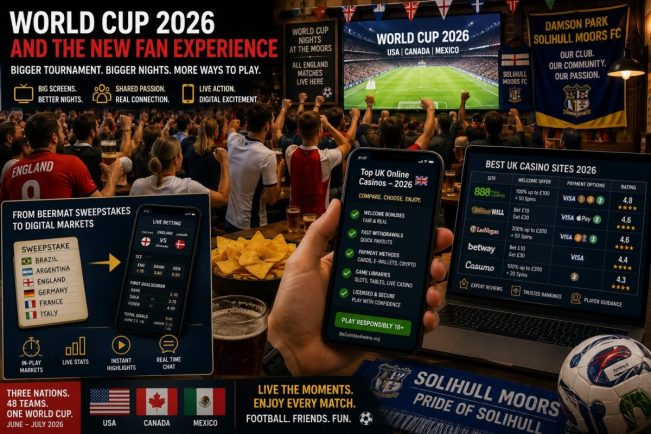
Among the most talked-about parts of that digital shift is the world of online entertainment that many UK adults now dip into around big sporting moments. There are detailed guides ranking the top operators offering casino online across the UK, and these reviews compare the things a curious adult actually wants to weigh up before choosing where to play: the size and fairness of welcome bonuses, how realistic the wagering requirements are, which payment methods are accepted, how quickly winnings reach an account, and which studios supply the slots and table games. For someone in the West Midlands looking to combine a flutter on a World Cup game with a few rounds of online slots, those side-by-side comparisons take the guesswork out of a crowded market, laying out sports betting markets and casino libraries in one clear ranking.
How Tournament Watching Has Changed
Cast the mind back to a World Cup a couple of decades ago. The experience was simple: a television, a few mates, maybe a paper sweepstake passed round the office in Solihull town centre with names of countries scrawled on torn-up bits of paper. The biggest decision was whether to risk the BBC or ITV commentary.
Today the picture looks very different. A single match might be followed across a tablet, a phone and a smart television at once, with live stats, second-screen reaction and instant highlights all woven into the evening. The sweepstake hasn’t vanished — it has simply moved online and grown more sophisticated. Where a fan once guessed at the final score on a beermat, now there are dozens of markets to consider, from first goalscorer to the number of corners, all available from the sofa.
From Beermat Sweepstakes to Digital Markets
This evolution mirrors a broader change in how British adults spend their leisure time. The pub quiz, the lottery ticket, the Grand National flutter that even non-racing folk indulged in once a year — these were the gentle gambles of an earlier era. They were occasional, communal and tied to a specific event.
The modern version is far more constant and personalised. Researchers have taken a keen interest in this shift, exploring how engagement and even mild obsession take shape around the modern game. One thoughtful study on obsession and engagement in sports betting examines the moral tensions that arise when wagering becomes tightly bound up with the emotional highs and lows of supporting a team. It is a reminder that the leisure landscape, for all its convenience, deserves a measure of awareness.
The Match-Day Atmosphere, Then and Now
There is something timeless about the atmosphere of a major tournament. The shared groans, the eruptions of joy, the agonising penalty shoot-outs that have a particular grip on English hearts. Damson Park may not host a World Cup, but the same energy that fills a Solihull Moors promotion push translates neatly onto the international stage.
What has changed is the texture around that core experience. Where supporters once relied solely on the back pages of the morning paper, they now arrive at the screen armed with form guides, expected-goals charts and a working knowledge of obscure full-backs from the other side of the world. Academics have been quick to study these wider effects too. A panel of experts on betting’s impact on society has explored how deeply entwined wagering has become with the way modern sport is consumed, marketed and discussed.
Marketing, Football and the Modern Fan
Anyone who has watched a televised match recently will have noticed how visible betting and entertainment brands have become around the game. Pitch-side hoardings, shirt sponsors and pre-match adverts have made the connection between football and gambling almost seamless. This is not entirely new — football programmes have long carried advertising — but the scale today is striking.
Studies have documented this carefully, including research into marketing in soccer matchday programmes, which traces how gambling and alcohol promotion has woven itself into the printed and digital fabric of the sport. For the Solihull fan settling in for a group-stage game, that backdrop is simply part of the modern viewing experience, even if few stop to think about how recently it arrived.
Enjoying the Summer of Football
For all the change, the heart of a World Cup remains gloriously simple: a packed front room, a fridge stocked for the evening, and ninety minutes of drama that can swing on a single moment. The digital extras — the live markets, the slots, the second-screen banter — are precisely that, extras layered onto a tradition that holds firm.
Plenty of West Midlands supporters will dip into a little online entertainment over the tournament, and the smart approach is the same as with any leisure pursuit: set a budget, treat it as fun rather than income, and keep the focus on the football. Done with that mindset, the new world of digital fandom can add a genuine spark to a summer that Solihull, like the rest of the country, will not forget in a hurry.