Social media is no longer a pastime in today’s world. It has now found a way into how we interact, communicate, and even view the world around us.
The truth is that the impact that social media has on one’s mental health isn’t exactly one-size-fits-all. The bottom line is the manner in which you use it. Overuse of the screen has the potential to undermine health significantly. The same websites are also being used to fight stigmas and begin important conversations about the subject of mental health.

As such, social media is a two-edged sword. It is best to learn how to balance its use to maximise it. This article will enlighten you on everything you need to know about social media and mental health. Let’s get right into it.
How Social Media Affects Mental Health
Social media can quietly shape the way we see ourselves. Some people may view it as a lifeline to community and support. Others see a source of stress, pressure, or comparison. Moreover, social media is so engaging that you won’t know when you’ll get carried away. So, how does spending time online affect your mental health?
Fear of Missing Out
FOMO is one of the reasons why people spend too much time on social media. This is birthed by the belief that something will happen in their absence. They then tend to stay on these apps for an extensive period.
Cyberbullying and Harassment
Harassment has always been a thing of concern on social media. Many people make hurtful comments just to get a reaction. This can affect your self-esteem and contribute to other mental health issues.
Body Image Issues
Social media popularised filters and editing tools that enhance pictures and videos. These filters reshape the face to give a “perfect” look. Over time, relying on them can distort self-perception.
Online Validation
People tend to subconsciously seek validation as they consume other people’s content on social media. The urge to replicate such a thing eventually comes in. For instance, suppose you post some content, and it ends up getting a lot of engagement. You likely find yourself checking your phone and craving more validation.
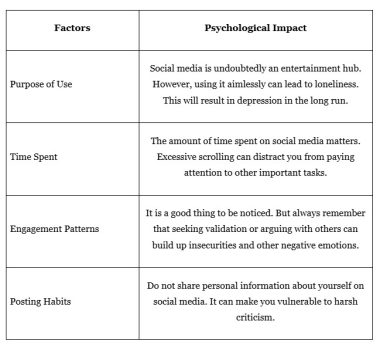
Factors That Influence Social Media’s Impact

The way you use social media can directly influence your mental health and productivity. The table below reveals some of the key factors that shape social media’s impact:
Signs That Social Media Is Affecting Your Mental Health
The body tends to develop a coping mechanism as we use social media daily. This is why it is tricky to spot improper usage of social media. Below are signs that indicate social media is affecting your mental health:
Screen Addiction
Social media can make you overlook other important life activities. Leave the screen and start executing real-life tasks. Suppose you can’t do without the urge to check your phone for notifications. This is a sign that you’re addicted.
Disorganised Sleep Patterns
Excessive social media usage can disrupt your sleep routine. This can have long-term effects on your personal and daily lives.
Reduced Productivity
Poor use of social media can make you less productive. Before you know it, you may struggle to complete tasks that you usually handle with ease. Repeated exposure can also affect your attention span.
Mood Swings
One of the easiest pointers is when you notice how fast your mood shifts while scrolling. Not feeling too good or having mixed emotions after seeing a post on social media can be a warning sign.
Fatigue
Spending too much time on social media apps can leave you feeling physically drained. The platforms are so engaging that you won’t notice how much time is spent – even when you are in uncomfortable positions.
Tips for Healthy and Productive Social Media Use
Social media is an unavoidable part of today’s world. It is a no-brainer that everyone is somewhat vulnerable to its negative effects. However, you can reduce these impacts. Below are a few practical tips to protect your mental health:
- Set Time Limit: Time is the most valuable asset you have. Don’t just waste it on unworthy tasks. Schedule time for everything to avoid burnout. The time for video games should not be used to read or scroll endlessly on social media.
- Deactivate Notifications: The constant buzzing of your phone’s notifications can be a distraction. One smart thing to do on a break is to turn off post notifications and leave them alone.
- Be Selective With the Content You Engage With: You’ll engage more meaningfully with content that inspires and uplifts you. The same can apply to your time spent on online entertainment, where you can simply relax and unwind in front of the screen. When choosing reliable platforms, nothing should disrupt your calm and leisure, so it’s best to opt for sites with PayPal, crypto, or other fast and secure payment methods. Enjoy your time online without worrying about your transactions.
- Personalise Your Feeds: It is worth noting that not all content on social media is for you. Thankfully, social media algorithms are designed to suggest relevant content that matches your taste. It studies the video you watch, the post you engage with, and every little bit of your activity on social media. Endeavour to organise your social media to ensure it only suggests positive content that uplifts your spirit.
- Escape From the Screen: Life doesn’t start and end on social media. Build a life outside the internet. Take a walk and build genuine relationships with people.
- Seek Help: The only cure for grief is action. And most times, that action begins with seeking support.
Conclusion
The importance of social media in today’s interconnected world cannot be overemphasised. However, it can also trigger several mental health issues. The leading cause of these issues is a result of excessive usage, aimless scrolling, and the pressure to keep up with unrealistic standards.
Thankfully, you can maximise social media and use it in a way that shapes your life positively. The goal is to control how you use social media, and not the other way round.
Submitted article written by Tim Cline