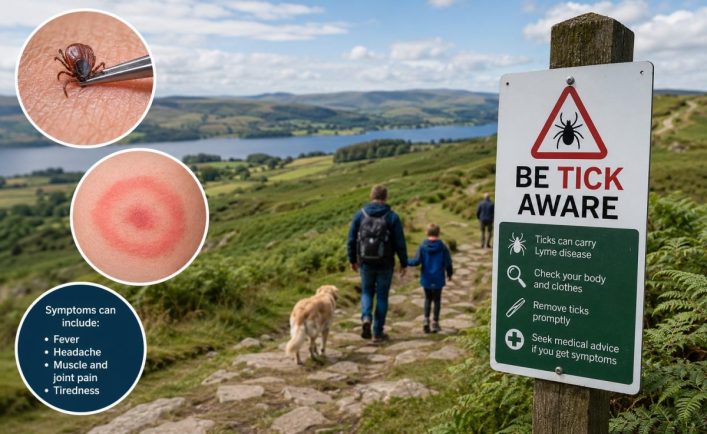
The danger can be no bigger than a poppy seed.
Hidden in long grass, woodland undergrowth and moorland scrub, ticks, tiny blood feeding arachnids, are becoming an increasing public health concern across Britain. And with more people spending time outdoors, health experts are warning that Lyme disease is being identified in growing numbers across the UK.
Lyme disease is a bacterial infection spread through the bite of infected ticks. Once considered relatively uncommon and largely confined to remote countryside, it is now being recognised far more widely throughout the UK.
According to the UK Health Security Agency, confirmed Lyme disease cases in England rose sharply in 2025, increasing by more than 20 per cent in a single year. Officials recorded 1,168 laboratory confirmed infections, although specialists believe the true figure is likely to be considerably higher because many patients are diagnosed based on symptoms alone.
For millions of Britons enjoying walking, hiking, camping and countryside pursuits, the issue is becoming increasingly difficult to ignore.
The illness that can be difficult to spot
Lyme disease is caused by the bacterium Borrelia burgdorferi, which can be carried by ticks found throughout the UK. Not every tick carries the infection, and most bites do not lead to illness, but when infection occurs early treatment is important.
The most recognisable symptom is a circular or oval rash which spreads outwards from the bite site, sometimes creating the distinctive “bullseye” pattern associated with Lyme disease. The rash may appear days or weeks after a bite and can be harder to detect on darker skin tones.
Many people, however, never notice a tick bite at all.
Ticks attach painlessly and are often found in difficult to spot areas such as behind the knees, under the arms or along the hairline. Some people instead develop flu like symptoms, including fever, exhaustion, headaches, muscle pain and aching joints. Left untreated, the infection can spread to the nervous system, heart and joints.
Doctors say Lyme disease remains notoriously difficult to diagnose because its symptoms overlap with a wide range of other illnesses, including chronic fatigue syndrome, fibromyalgia and viral infections.
The NHS warns that blood tests are not always reliable during the early stages of infection, meaning patients with clear symptoms may initially test negative.
While most patients recover fully after antibiotics, others report long lasting exhaustion, neurological symptoms and chronic pain that can continue for months or even years. Scientists still do not fully understand why some people continue to experience symptoms after treatment.
Identifying a Tick Bite
- What they look like: Ticks are tiny, spider-like creatures found in woodland, moorland, and grassy areas. Once attached, they embed their mouthparts into the skin and feed on blood.
- The “Bull’s-eye” Rash: The most common early sign is an expanding circular or oval pink, red, or purple rash. It often features a darker outer ring with a clearer center, resembling a target.
- Other Early Symptoms: Flu-like signs such as fever, headache, extreme tiredness, and joint/muscle aches often accompany the rash
The precautions experts say everyone should take
Health experts stress that people should not avoid the countryside. Instead, awareness and prevention remain the most effective forms of protection.
The NHS advises walkers, runners and campers to cover exposed skin, wear light coloured clothing so ticks are easier to spot, and use insect repellents containing DEET when spending time in grassy or wooded areas. Staying on clear paths can also reduce the likelihood of exposure.
Checking the body carefully after outdoor activity is also important.
Ticks should be removed as quickly as possible using fine tipped tweezers or a specialist removal tool. The NHS advises grasping the tick close to the skin and pulling upwards slowly without squeezing or crushing it.
Doctors say anyone who develops flu like symptoms or an unusual rash after spending time outdoors should seek medical advice promptly, even if they never noticed a tick bite.
A growing public health issue
Lyme disease remains one of the least understood illnesses affecting thousands of people across Britain each year. Unlike many infectious diseases, its symptoms are often vague, diagnosis can be difficult, and patients frequently face delays before receiving treatment.
But awareness is slowly increasing.
As more Britons spend time walking, running and holidaying in the countryside, health officials say understanding the risks posed by ticks has become increasingly important. Early diagnosis and prompt treatment remain the best defence.
For most people, a tick bite will cause no lasting harm. Yet experts warn that recognising the signs of Lyme disease quickly can make the difference between a short course of antibiotics and months, or even years, of debilitating illness.
REMEMBER: Early and correct removal of an attached tick within 24 to 48 hours greatly reduces your risk of infection. The condition is highly curable with prompt oral antibiotics.
NHS advice is as follows:
To remove a tick safely
- Use fine-tipped tweezers or a tick-removal tool. You can buy these from some pharmacies, vets and pet shops.
- Grasp the tick as close to the skin as possible.
- Slowly pull upwards, taking care not to squeeze or crush the tick. Dispose of it when you have removed it.
- Clean the bite with antiseptic or soap and water.
The chance of getting ill is low. You do not need to do anything else unless you notice a rash or become unwell.
Ask for an urgent GP appointment or get help from NHS 111 if:
You’ve been bitten by a tick or visited an area in the past 3 months where infected ticks could be, and you either:
- feel unwell with flu-like symptoms – such as feeling hot or cold, feeling shivery, headaches or aching muscles
- have a round or oval shape rash
- Tell them if you have recently been in forests or grassy areas.
You can call 111 or get help from 111 online.
For more information visit the NHS information page here.