A SOLIHULL woman has welcomed news that NHS patients around the country are now receiving a lifesaving medicine made from the plasma of blood donors in the West Midlands.
This historic milestone marks the first time in a quarter of a century plasma is being used to make life-saving medicines for NHS patients, reducing reliance on imports.
These lifesaving medicines can only be made from human blood. Plasma makes up 55 per cent of our blood and contains antibodies which strengthen or stabilise the immune system.
The antibodies are separated out and made into medicines which treat people with life limiting illnesses such as immune deficiencies.
Over the past three years, plasma from blood donors in West Midlands and across England has been stored up, and it has now been made into medicines through a weeks long manufacturing process. The first patients are now receiving the medicines.
Across the West Midlands, around 1,100 receive immunoglobulin each year. One of the largest users is University Hospitals Birmingham NHS Foundation Trust (UHB), where 410 patients received immunoglobulin the last reported year.
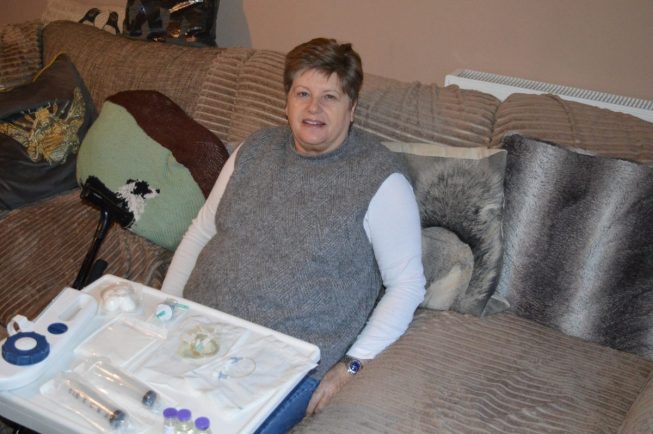
Karen Howarth is one of those who rely on immunoglobulin for an incurable ‘one in a million’ illness – Stiff Person Syndrome.
The neurons that control her muscles are misfiring, causing her body to tense and spasm and people with the condition can become immobile, require intensive care, and even die.
The exact mechanism is unknown but it’s understood to be an autoimmune disease where the patient’s antibodies – part of the immune system – cause the neurons that control the muscles to misfire.
The 61-year-old said: “It’s a relief to know we’re now making it from local blood donations too.
“I am so grateful to everyone who donates blood.
“You are not just helping people with your red blood cells – now the plasma in your blood donation is helping people too.”
Last year, just under 100 people in England received immunoglobulin for Stiff Person Syndrome. It becomes most serious when it affects breathing.
Karen was diagnosed around 10 years ago after suffering muscle spasms, muscle stiffness, backpain, and fatigue.
She has received regular infusions of immunoglobulin ever since and currently gives herself a home infusion once a week.
The medicine is made from the antibodies of plasma donors. Those normal antibodies help her own immune system to temporarily stabilise. It eases her symptoms and slows their long-term progression.
Karen, a retired teaching assistant, who is married and has one son, is under the care of Heartlands Hospital, which is overseen by UHB.
She said: “It has badly affected my mobility. I have now progressed to the point where I need a mobility scooter.
“But I would have progressed to that point years ago if it wasn’t for the immunoglobulin.
“It basically changed my life. I would be far worse now without it. When I first got it, I was able to live as normal a life as possible.”
There are two ways that you can give plasma. Every time you give blood in West Midlands, your plasma may be used too. Or you can donate plasma at three specialist sites in Birmingham, London and Reading.
Daniel Cooper, NHSBT assistant director for blood donation operations, said: “Thanks to our amazing blood and plasma donors in West Midlands and across England, for the first time in a quarter of a century, patients are now receiving plasma medicines made from donations taken in England.
“We need more blood donors to help make more of these medicines and build UK self-sufficiency. Your donation is now helping save lives in new ways. Go to blood.co.uk to become a donor.”