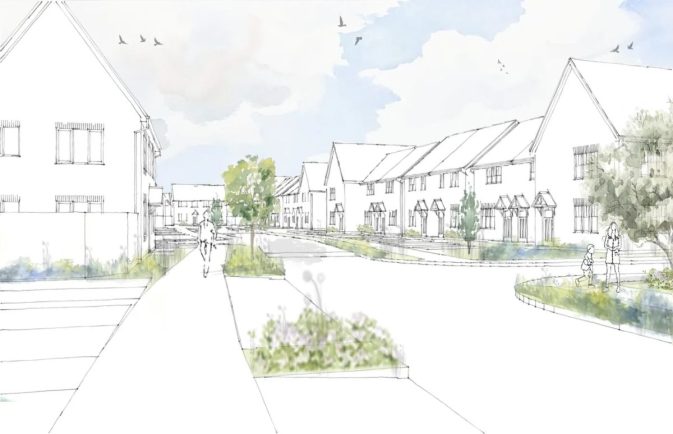
Platform Housing Group has forward purchased all 177 homes being built by Vistry on the site of the former Simon Digby School in Chelmsley Wood, in a deal that will see the entire development handed over as 100% affordable housing.
The scheme, on a 4.5-hectare brownfield site between Chester Road (A452) and the M6, has been earmarked for housing since it was included in Solihull Council’s Local Plan back in 2013.
Under the arrangement, Platform will own and manage every home once built, rather than any being sold on the open market.
What’s being built
The development will offer a mix of two-, three- and four-bedroom family houses alongside one-bedroom maisonettes, designed to reflect local housing need. Alongside the homes, the plans include a children’s play area, a nature trail and new areas of public open space, with the site sitting next to an existing nature reserve.
The homes will not be built on-site in the traditional sense. Instead, they are being manufactured using modern methods of construction, with open-panel timber frames produced off-site at Vistry’s Works East Midlands factory in Leicestershire before being assembled in Chelmsley Wood. Vistry says the approach significantly cuts the embodied carbon of each property compared with a conventional brick-and-block build, as well as making homes cheaper to heat.
Community investment
The scheme also carries just under £2 million of Section 106 investment — £1,989,598.08 — earmarked for local services, with contributions going towards education, public open space, healthcare, playing pitches, transport and biodiversity net gain.
Fraser Hopes, acting managing director of Vistry South West Midlands, said the partnership would make a meaningful contribution to addressing local housing need, while delivering high-quality family homes built to a more sustainable standard. Kate Ellison, Platform’s director of growth and innovation, said the scheme reflected the value of partnership working between organisations with a shared commitment to affordable housing, adding that the area had long been a priority for Platform given its location and the high demand for affordable homes locally.
Councillor Mark Parker, Solihull Council’s cabinet member for housing, said the development showed how strong partnerships could deliver the homes residents need, and credited years of council masterplanning and feasibility work for unlocking the site’s potential. He said the scheme would also bring investment into community infrastructure and new public spaces alongside the housing itself, and that working with partners and the WMCA was turning underused land into a neighbourhood that would benefit Solihull residents for generations to come.
A long road to delivery
The site’s route to development has been years in the making. Solihull Council carried out extensive feasibility studies and masterplanning work, supported by funding from the West Midlands Combined Authority (WMCA), before appointing Vistry as its development partner in October 2024 following a competitive tender process. The WMCA has also contributed just under £3 million towards the scheme through its devolved housing and land funds.
Planning permission was formally granted in March 2026, clearing the way for construction to begin. The forward purchase agreement with Platform, confirmed this month, means the homes’ long-term ownership is now settled before a single property has been completed.
Council figures have pointed to the scheme’s location near the planned HS2 interchange and the wider UK Central Hub as a factor in its significance for the area, with the development expected to knit into the existing Chelmsley Wood community rather than stand apart from it.
Vistry’s wider troubles
The announcement lands against a difficult backdrop for Vistry. The housebuilder has issued a series of profit warnings over recent months and has seen both its chief executive and chair leave the company. Last month it invited staff to apply for a voluntary exit scheme as part of a wider cost-cutting drive. Despite this, the Chelmsley Wood partnership with Platform represents a continuation of an existing relationship between the two organisations, who have worked together on affordable housing elsewhere in the past.
Construction is expected to proceed now that planning consent and the forward funding arrangement are both in place, with the site set to become a new residential community anchored by affordable housing for local people.