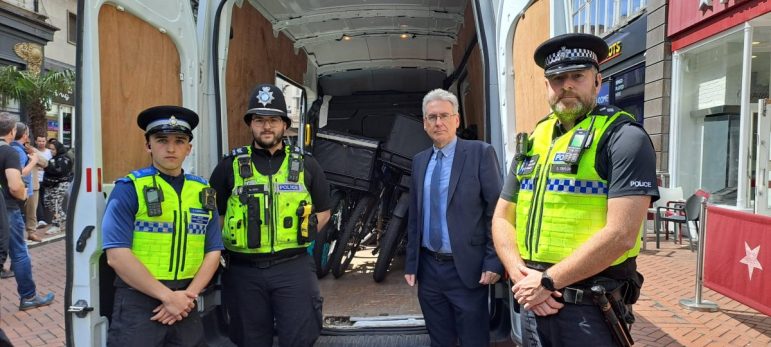
THE POLICE and Crime Commissioner is calling for urgent changes to the law to allow the police to destroy vehicles used to commit crime and anti-social behaviour, within seven days of seizure rather than 14.
Simon Foster’s proposal, submitted as part of a national consultation on amendments to vehicle seizure and disposal legislation, is aimed at tackling the growing threat posed by e-bikes, e-scooters and other vehicles being used recklessly and unlawfully on the region’s roads.
Many of these vehicles – particularly modified e-bikes – are capable of reaching speeds of over 70 mph, almost five times faster than the 15.5mph legal limit, and are increasingly being used by criminal gangs and networks. Their speed, agility, and lack of registration make them ideal for evading police and intimidating the public.
At the moment the police have to store seized vehicles for 14 days, but the PCC wants that halved.
He said: “These vehicles are often being used to commit crime and cause fear in our communities.
“They are fast, nimble, and often modified to exceed legal limits. They are used by individuals who have no regard for public safety, and their presence can be both dangerous and intimidating.”
The PCC’s proposal is grounded in his Police and Crime Plan 2025–2029, which prioritises preventing and reducing crime and anti-social behaviour, promoting road harm reduction and reducing the number of people tragically and avoidably killed or seriously injured on the roads.
The proposal was developed in close collaboration with West Midlands Police’s Anti-Social Behaviour and Roads Policing teams.
Officers report that these vehicles are often used without insurance, registration, or safety equipment, and are frequently involved in dangerous group riding, off-road activity, and pavement use.
The PCC also emphasised the need for appropriate checks and balances, to ensure that innocent vehicle owners are not unfairly penalised, while also recognising that most vehicles used in this way are never reclaimed and pose a continued risk, if returned to the streets.
The proposed change would also reduce storage costs, improve operational efficiency, and send a clear deterrent message, to those engaging in criminal and anti-social and behaviour.
As part of his plan to improve road and travel safety in the West Midlands, the PCC has also pledged to advocate for strict regulations on the weight, power and speed of privately-owned e-scooters, should their use in public spaces be legalised in the UK.
Privately owned e-scooters are still illegal to use on public roads, pavements and cycle lanes in the UK. However, they can only be used on private land with the landowner’s permission.
Rental e-scooters that are part of government-approved trials are legal to use in designated areas and must follow specific rules such as speed limits, age restrictions and insurance requirements.