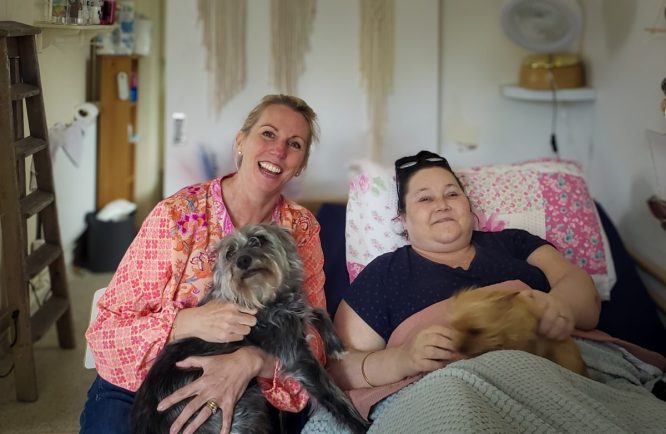
SUPPORTING patients with emotional and practical companionship is all part of the job for a companion at Marie Curie.
However one volunteer, Nicola Bowen, has made a special connection and has found friendship with the woman she was paired with.
Kelly Robinson, 42, was diagnosed with heart failure in 2020.
Following an unsuccessful operation, intended to improve her heart function, Kelly’s health deteriorated.
As a result of her condition, she will not recover from her illness and is bedbound.
Kelly said: “Life after my diagnosis was very lonely and difficult, it felt as though I had been lost in the system and forgotten.
“Even though I have a loving family, I didn’t have an outlet to grieve for my past life and my stolen future.
“I felt I was becoming a huge burden on Martin, my husband, and on my kids. I had to keep my feelings locked away, as I didn’t want to burden them further. I was shut off from the world; everyday was ground hog day.”
In autumn 2023, during a visit from district nurses, Kelly broke down in tears, and it was suggested that she may benefit from support from Marie Curie.
The charity provides end of life care for people with any illness they are likely to die from including Alzheimer’s (and other forms of dementia), heart, liver, kidney and lung disease, motor neurone disease, Parkinson’s, and advanced cancer.
In January 2024, Kelly was matched with Marie Curie companion volunteer Nicola Bowen.
Companions provide emotional support as well as practical help taking patients to hospital appointments, social events or just helping with everyday tasks.
Volunteers can also provide information on further support and services available in their local area and provide support to families for up to three months after bereavement.
Kelly said: “I knew from the first meeting, that we would get on. I don’t have much to look forward to, but I look forward to every Wednesday, when Nicola visits for a couple of hours. I can say anything to Nicola, get things off my chest and it has made a positive difference to my mental health.
“I see Nicola not only as a companion, but as a best friend. We have children of similar ages and talk about our teenagers. I often feel inadequate as a mother. Nicola reassures me that I am enough. Our chats balance me.”
Over the past few months, Nicola has helped Kelly and Martin with household chores and find a martial arts club for their son.
Nicola Bowen began volunteering for Marie Curie in 2017 and has supported five families since joining the charity.
The 54-year-old said: “I lost my aunt to cancer in 2014. She was only 64 and had a lot of love and support. I remember thinking at the time, ‘how do people who are alone manage at the end of their lives?’.
“In 2017, I decided I would like to become a companion volunteer at Marie Curie, I didn’t tell anyone I was joining, not even my husband. I knew what people would say “I couldn’t do that. Won’t it be too upsetting?
“I joined to ‘give back’, but I have gained so very much. People at the end of life don’t want to be a diagnosis, they want to be themselves. Some weeks, we chat about life’s goings on, family and favourite memories. Other weeks, life may be more challenging, and if necessary, I call on additional support.
“I consider my companion role as a friend with the right connections. Marie Curie has so many resources, from social workers, grief counsellors, physiotherapists, and various support groups at the hospice.”
For or to find out about volunteering visit the Marie Curie website.