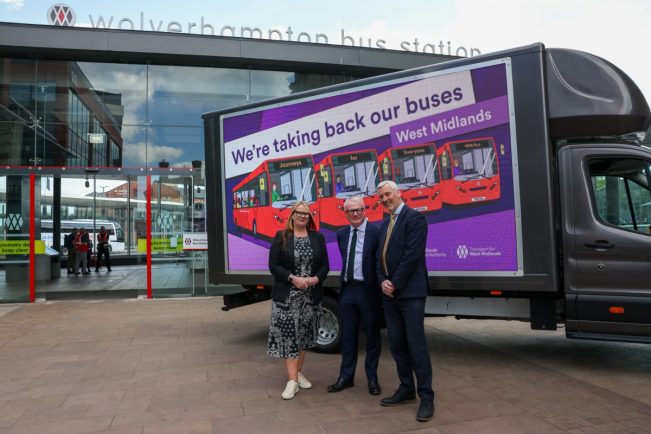
PLANS to revolutionise the region’s buses to bring the network under public control for the first time in 40 years have been given the green light.
The landmark decision was signed by the West Midlands Mayor, Richard Parker, after approval from the West Midlands Combined Authority (WMCA) Board.
The transition process towards franchised bus services – replacing the current private operator-led network – is now set to get under way.
The first public controlled services, which are likely to include a non-stop Sprint service from Walsall to Solihull via Birmingham city centre, are expected to start rolling out in late 2027, with the whole process finished during 2029.
The Mayor said: “For too long, our buses have been run for private profits, not public good. Today, that changes.
“The public have been clear – they want a better bus service under public control, and I’ve heard them loud and clear. I promised to take back control of our buses – and today’s decision shows we’re delivering on that promise.
“The work is now underway, and over the next two years we’ll create a bus network that puts passengers first – reliable, affordable and run in the interests of the people that use them.”
With 236million journeys last year, buses account for eight in ten public transport trips. A well-used and low emission network is seen as a crucial part of the region’s plans to cut traffic congestion and improve air quality and the environment.
Under franchising, Transport for West Midlands (TfWM), which is part of the WMCA, will set the fares, timetables and routes of bus services and award a series of contracts to private bus operators to run them. This means that the politically accountable Mayor and regional leaders, through TfWM, will be able to design a network which best serves residents and businesses.
There are expected to be nine local area franchises with three rolled out each year from 2027-2029, plus a number of smaller single route contracts to encourage smaller bus operators to bid.
Antony Goozee, bus strategy and commercial director at National Express West Midlands, said: “As a leading bus operator in the West Midlands, we take great pride in running bus services in the region, carrying more than 4.5 million passengers every week.
“We recognise the ambitions of the Mayor and the WMCA to significantly invest in the bus network and develop a new operating model that maximises value for public investment, enhances mobility, and supports economic growth across the region.
“Our long-standing and successful partnership with Transport for West Midlands is something we greatly value. Drawing on decades of experience, we remain fully committed to working collaboratively to deliver high-quality bus services, supporting a smooth and effective transition to the new franchising model as well as continuing to improve our service excellence well into the future.”
An extensive consultation earlier this year found 75 per cent of residents and organisations who expressed a preference were in support of franchising. This included a majority of bus operators and local councils.
The one-off costs of setting up the new franchised operation and designing the new network is expected to be £22.5 million over three years.
Bus depots, the WMCA already owns one in Walsall, and a fleet of more than 1,000 buses will also be needed – either bought outright or leased using either the authority’s transport grants or borrowing through fare income. This will increase competition by opening up the new franchises to a wider range of operators.
The WMCA say the private operator-led bus network has struggled with rising costs in recent years and is currently being propped up with £50million a year of taxpayers’ money to prevent more services from being cut.
Last year an independent audit found that through increased competition among operators franchising would offer better value for money – whatever the level of public funding.