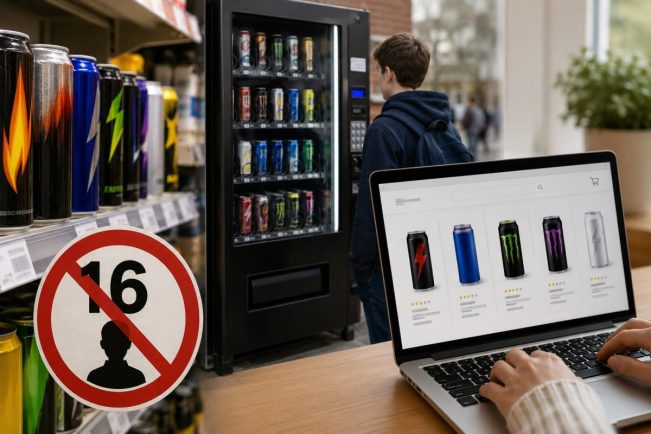
Shops, vending machines and websites in England will be barred from selling high caffeine energy drinks to anyone under 16 from April 2027, the government confirmed this week, in a move ministers say will protect children’s physical and mental wellbeing.
The Department of Health and Social Care and the Department for Education announced the ban on 16 July, following a public consultation that drew almost 1,100 responses from businesses, health bodies, enforcement agencies and members of the public. Officials say the responses showed strong backing for introducing an age limit on the drinks.
Health officials estimate that roughly 100,000 children across England drink heavily caffeinated energy drinks on a daily basis, and say a growing body of evidence links this to problems including anxiety, disrupted sleep, poor concentration and weaker academic performance. Children from poorer households and areas are said to be especially likely to consume the drinks, compounding existing health inequalities and setbacks to their learning.
Public Health Minister Sharon Hodgson said the drinks had no place in the hands of children, arguing that daily consumption by so many young people was clearly linked to anxiety and disruption to sleep, focus and schooling. She described the ban as central to the government’s ambition to raise the healthiest generation of children on record.
Education Minister Olivia Bailey said restricting access to the drinks would help protect pupils’ health and ability to concentrate in class, and pointed to it as complementing separate government plans to reform school food for the first time in more than ten years.
Under the new rules, any soft drink other than tea or coffee containing more than 150mg of caffeine per litre will be covered by the restriction. The ban will apply to shops, vending machines and online retailers, though sales between businesses will not be affected. Enforcement will fall to local authorities, while shopkeepers and retailers will carry responsibility for ensuring the drinks are not sold to under 16s. Firms that breach the rules could face fines of as much as £2,500.
The government intends to introduce the change through secondary legislation under the Food Safety Act 1990, with the restriction due to take effect in April 2027 once it clears Parliament.
Campaigners welcomed the announcement but urged ministers to move quickly. Katharine Jenner of the Obesity Health Alliance called the policy popular with parents, health professionals and the wider public, and said it marked a genuine step toward safeguarding children’s health, while pressing the government to now secure parliamentary approval and ensure enforcement is effective in time for the 2027 start date.
Barbara Crowther of the Children’s Food Campaign at Sustain said the evidence of harm to children’s physical, mental and dental health was overwhelming, and noted that the ban comes two years after Labour first pledged to act, during which time she estimated close to 300 million more high caffeine energy drinks had been sold to children. She called for the legislation to be brought before Parliament without further delay.
Nineteen year old Bite Back youth activist Carrera said young people had long been raising concerns about how normalised the drinks had become in schools, on school journeys and through social media influencers and sport, describing them as having effectively become playground currency. She said the timing was particularly significant, coming as many pupils had just finished sitting exams.
Sarah Muckle, policy co-lead for children and young people at the Association of Directors of Public Health and director of public health for Essex County Council, said energy drinks carried real risks for children including tooth decay, disrupted sleep and a heightened risk of high blood pressure, and that restricting access would be especially beneficial for children in the most deprived communities.
The ban forms part of a wider package of measures aimed at tackling childhood obesity and improving children’s health, alongside plans to extend the Soft Drinks Industry Levy, introduce supervised toothbrushing for three to five year olds in deprived areas, and impose tighter restrictions on where less healthy food can be displayed in shops, included in multibuy promotions, or advertised at times when children are likely to be watching.
The consultation that preceded the announcement ran from 3 September to 26 November 2025 and attracted 1,095 responses in total.
Main Image: For illustration purposes only.