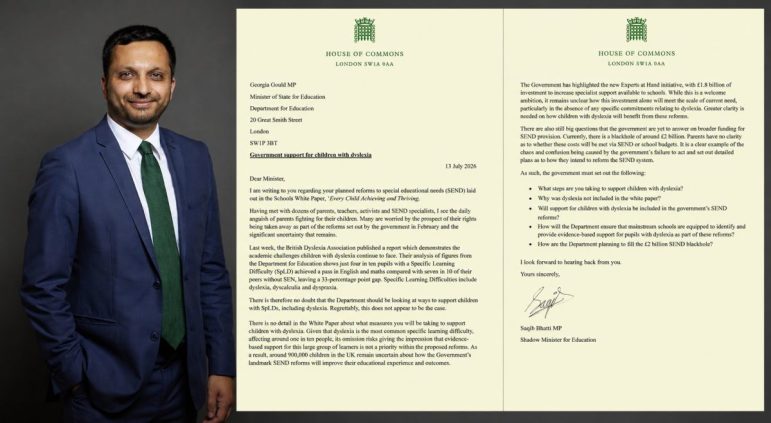
Saqib Bhatti, MP for Meriden and Solihull East, has written to the Minister for Education demanding clarity on how the Government’s planned reforms to special educational needs (SEND) provision will support children with dyslexia.
In a letter sent on 13 July to Georgia Gould MP, Minister of State for Education, Mr Bhatti raised concerns that dyslexia was not mentioned in the Government’s Schools White Paper, “Every Child Achieving and Thriving,” despite it being the most common specific learning difficulty, affecting around one in ten people.
The MP said the omission had left families across the country, including many in Solihull, facing significant uncertainty. He explained that his letter followed conversations with parents, teachers, campaigners and SEND specialists, who described the daily challenges of fighting for the right support for their children.
Mr Bhatti’s letter cited a recent report from the British Dyslexia Association, which found that only four in ten pupils with a specific learning difficulty achieved a pass in English and maths, compared with seven in ten of their peers without special educational needs, a 33-percentage point gap. He warned that, with an estimated 900,000 children in the UK affected, the lack of detail in the White Paper risked signalling that support for this large group of learners was not a priority.
The letter also questioned how the Government’s £1.8 billion Experts at Hand initiative, designed to boost specialist support in schools, would address the scale of need without specific commitments on dyslexia. Mr Bhatti further highlighted what he described as a £2 billion funding gap in SEND provision, leaving parents unclear whether related costs would be met through SEND or general school budgets.
In the letter, Mr Bhatti put five questions to the Minister, asking what steps are being taken to support children with dyslexia, why the condition was left out of the White Paper, whether dyslexia support will feature in the wider SEND reforms, how mainstream schools will be equipped to identify and support affected pupils, and how the Government plans to address the SEND funding shortfall.
Speaking about his letter, Mr Bhatti said children with dyslexia and their families deserve clarity, confidence and a Government that puts their education first.
He is now awaiting a response from the Department for Education.