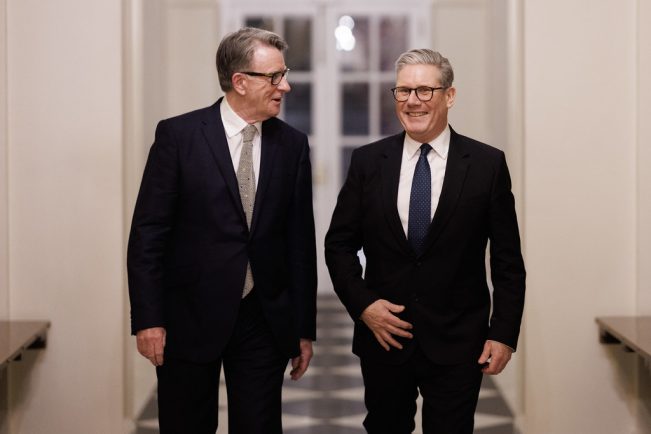
Pressure is mounting on Sir Keir Starmer to step down as prime minister, as politicians from across the political spectrum openly question his account of the handling of Peter Mandelson’s failed security vetting and whether he misled Parliament.
The crisis follows revelations that Mandelson was appointed UK ambassador to the United States despite the government’s vetting service recommending against his clearance, a decision that was subsequently allowed to stand.
Starmer has insisted he was not informed of the failed vetting at the time, describing the situation as “staggering” and “unforgivable”, while placing responsibility on officials within the Foreign Office. However, that explanation has been met with widespread disbelief in Westminster.
Opposition demands resignation
Kemi Badenoch said the prime minister’s account was “completely preposterous” and argued that “all roads lead to resignation”.
Speaking in Westminster, she said Starmer could not “hope” to continue in office, accusing him of incompetence and of failing to grasp the seriousness of the situation. She added that while the Conservatives do not have the numbers to force a vote of no confidence, Labour MPs “should do the right thing”.
The criticism has not been confined to the Conservatives. Liberal Democrat leader Ed Davey said the prime minister’s explanation “just doesn’t stack up” and concluded that “he is going to have to go”.
The Liberal Democrats have also called for a formal investigation into whether Starmer misled Parliament, significantly raising the stakes of the controversy.
Independent reporting intensifies doubts
Further pressure has come from earlier reporting by David Maddox, political editor of The Independent, which directly challenges the prime minister’s claim that Downing Street was unaware of the issue.
In September 2025, Maddox reported that Mandelson had not cleared security vetting and that concerns had been raised at senior levels. He has since pointed to contemporaneous messages showing he put those claims directly to Downing Street at the time.
Maddox has said the suggestion that No 10 only became aware of the vetting failure this week is “complete nonsense”.
That reporting, and the evidence that Downing Street was questioned months ago, has sharpened doubts about the prime minister’s account and intensified scrutiny of what was later said to Parliament.
From process failure to a question of Parliament
The controversy is now shifting beyond questions of process into a far more serious issue, whether Parliament was given an accurate account.
Starmer previously told MPs that due process had been followed in Mandelson’s appointment. In light of the emerging details about a recommendation not to approve his vetting, critics argue that statement is difficult to reconcile with the known facts.
Under the ministerial code, ministers are required to give Parliament accurate and truthful information. Those who knowingly mislead Parliament are expected to resign.
Opposition parties are now explicitly framing the issue in those terms, calling for an investigation into whether the prime minister’s statements to MPs were accurate and whether they should have been corrected earlier.
While there is no definitive public evidence that Starmer deliberately misled Parliament, the gap between his previous assurances and the newly revealed details has become the central issue in the crisis.
Criticism spreads across parties
Other parties have also now joined the calls for Starmer to resign, including the SNP, the Green Party and Reform UK, turning the issue into a broad cross party challenge to his authority.
Significantly, criticism has also emerged from within Labour’s own ranks. Anas Sarwar said he stood by his call for Starmer to resign, describing the Mandelson affair as a “tipping point”.
That intervention underlines the depth of unease inside the party, where some MPs have privately questioned whether the prime minister’s explanation is credible.
A damaging sequence of events
The row has been fuelled by a series of disclosures about how Mandelson’s appointment was handled.
He was announced as ambassador in December 2024, before full vetting had been completed. He later took up the post in February 2025 and was dismissed seven months later following further revelations about his links to Jeffrey Epstein.
It has since emerged that the UK Security Vetting service recommended against granting clearance. Sources indicate that such recommendations are typically categorised as “yes”, “yes with caveats” or “no”, with Mandelson reportedly falling into the final category.
Despite this, the appointment proceeded, with the Foreign Office understood to have the authority to override such a recommendation.
Starmer has said neither he nor any minister was informed of that outcome at the time. Critics say that is difficult to reconcile with the sensitivity of the role and the seriousness of the concerns raised.
Questions over judgement and accountability
The controversy has also reignited scrutiny of the prime minister’s judgement.
In Westminster, the affair has been described as a messy and noisy episode, with growing questions about why Starmer did not probe more deeply into the vetting process for such a high profile appointment.
The sacking of senior civil servant Olly Robbins has done little to quell the criticism. Some figures with experience of Whitehall processes have suggested Robbins may have been following established protocols, while others question whether it is plausible that such a significant issue would not have been escalated.
Downing Street response
Challenged about reporting by The Independent and claims that it had been made aware of the vetting concerns months earlier, Downing Street said it did not “accept that a media inquiry is equivalent” to being formally informed.
Asked whether checks were made following the approach from the newspaper, a spokesperson said: “No 10 has repeatedly, throughout this process, asked about the facts surrounding this case, Peter Mandelson, his security vetting, and at no point in the process was No 10, the prime minister told that UK security vetting had recommended against him.”
Parliamentary showdown ahead
Attention is now turning to Parliament, where Starmer is expected to set out his account in full. Robbins has also been invited to give evidence to the Foreign Affairs Select Committee, raising the prospect of further damaging disclosures.
With elections looming and discontent growing inside Labour, the Mandelson affair risks becoming more than a procedural dispute.
It is now being framed by critics as a test not only of the prime minister’s judgement, but of whether Parliament was given a truthful account, a question which, under long standing constitutional conventions, goes directly to whether a prime minister can remain in office.