Ask most people what a Mayor actually does all day, and you’ll probably get a shrug, a mention of a big gold chain, and maybe something about cutting ribbons.
The reality, as one glance at Councillor Sardul Marwa MBE JP’s diary for the week ahead shows, is a good deal more relentless than that.
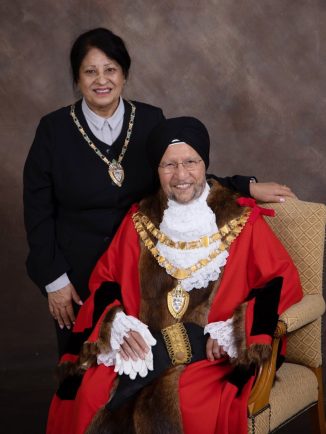
Cllr Marwa is Solihull’s 73rd Mayor, elected at the first full council meeting after May’s local elections, and he’s settling into a role with roots stretching back over seven decades.
Next week alone takes him from a graduation stage in Shirley to a citizenship ceremony in the Civic Suite, a diplomatic reception at a foreign consulate, and a community fete in Marston Green, already nine separate engagements in seven days, several of them with barely an hour’s turnaround between chain, car and next handshake.
What’s actually in the diary
The week opens on Monday with the Brama Trust Graduation Ceremony at Shirley Baptist Church, followed the same evening by the Solihull Tree Wardens’ monthly meeting back at the Civic Suite. Tuesday brings a mayoral briefing — the quieter, behind-the-scenes admin that keeps the whole operation running — before an evening of black tie for the 25th anniversary of local charity Breast Friends. Wednesday is a two-hander: the official opening of a wellness business on Stratford Road in the morning, then presiding over a Citizenship Ceremony in the Registrar’s Office, where new British citizens take their oath. Thursday is the one blank page in the diary — a rare free day. Friday mixes the ceremonial with the diplomatic: a visitor to the Mayor’s Parlour followed by a Safer Communities conference hosted at the Consulate General of Romania in Birmingham. The weekend keeps going too, with the Bickenhill and Marston Green Fete on Saturday and the Festival of Thetford and Punjab, the Thetford Mela, on Sunday, a considerable trip out of the borough entirely.
For most of these, the Mayor is accompanied by his Mayoress (in Cllr Marwa’s case, his wife Satnam) and a good number call for a speech, full chains of office, and the formal black jacket and pinstripes that mark out civic dress from ordinary council business.
So what actually is a Mayor?
It’s one of the most misunderstood jobs in local government, largely because the title covers two completely different roles.
An elected mayor (the kind found in London or Manchester) is a powerful executive who runs a council or region and sets policy, rather like an American city mayor. A civic or ceremonial mayor, which is what Solihull has, is something else entirely: a councillor chosen by their fellow councillors, for one year at a time, to be the borough’s first citizen and independent chair of full council meetings.
Crucially, the Mayor doesn’t run the council day-to-day (that’s the job of the council leader and cabinet) nor do they belong to one party while wearing the chain. Whatever their political colours the rest of the year, a civic mayor is expected to represent every resident of the borough without fear or favour for the duration of their term.
Presiding over council meetings is, on paper, the Mayor’s main statutory duty. In practice, that’s a fraction of the job. The rest is representing Solihull at almost anything that matters to the community: school visits, charity dinners, faith celebrations, sports clubs, business openings, remembrance services, sometimes several in a single day, as next week demonstrates.
The chain, the mace, and 1954
Solihull’s mayoralty is older than the modern borough itself. The town was incorporated as a municipal borough on 24 May 1954, and to mark the occasion Captain Oliver Bird presented the council with its ceremonial mace — a silver-gilt rod weighing around 2.5kg and made up of roughly 300 separate pieces, topped with a Royal Crown to signify that the office is held under the authority of the Crown. When the mace is present at a meeting, the Mayor is acting in official capacity; when it’s absent, the business isn’t official at all.
That original borough became the much larger Metropolitan Borough of Solihull in 1974, but the line of Mayors carried on unbroken — Cllr Marwa is the 73rd person to hold the office since 1954, a role that has been filled by police officers, teachers, electricians and, in his case, a former prisoner-finance worker at HMP Birmingham.
The Mayor’s Parlour in the Civic Suite (the same building that houses the borough’s register office) is reserved exclusively for the Mayor and their guests, complete with pieces from the council’s civic silver and a small collection of mayoral portraits.
Not just ribbon-cutting
It would be easy to write the mayoralty off as ceremonial fluff, but spend a week following the diary and a different picture emerges: a job that asks someone to be equally comfortable presiding over a solemn citizenship oath, chatting to schoolchildren about how democracy works, representing the borough to a foreign consulate, and still making it to a village fete by lunchtime on Saturday.
Cllr Marwa himself has spoken of wanting to use the year to promote civic pride and community cohesion across the borough. and on the evidence of next week’s diary, he’ll have plenty of chances to do exactly that.
Engagement details courtesy of the Mayor’s Office, Solihull MBC.