



THIS YEAR Polestar announced the largest model offensive in its history, with four new cars planned in the next three years.
The brand is still relatively new, only launching in 2017, and since then has gone from strength to strength, taking the electric car market by storm.
Over the next four years, Polestar’s lineup will include Polestar 5 – the four-door Grand Tourer (GT) presented in 2025, with deliveries expected from summer 2026.
Polestar 4, which is a new variant of the brands current best-seller based on same great technology, targeting a wider customer base by offering more versatility and is to be launched later this year, with deliveries expected to start in the fourth quarter of 2026.
Polestar 2, the next generation of the sedan that built Polestar’s brand, a completely new successor with a planned launch early in 2027 and Polestar 7 – the compact, premium SUV, planned to be launched in 2028.
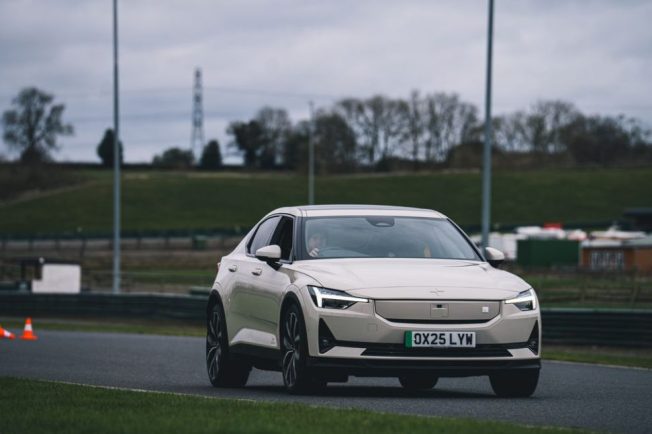
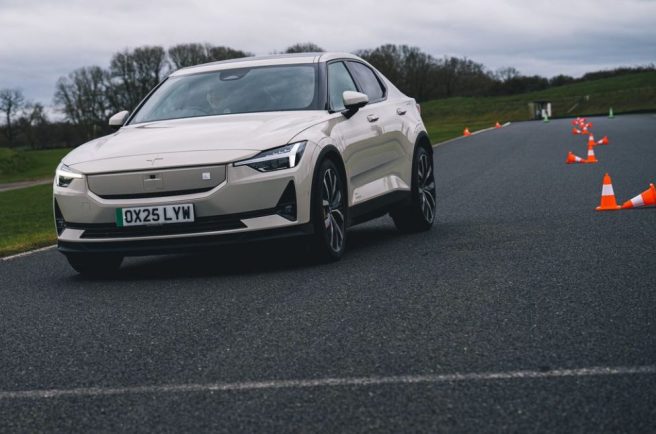
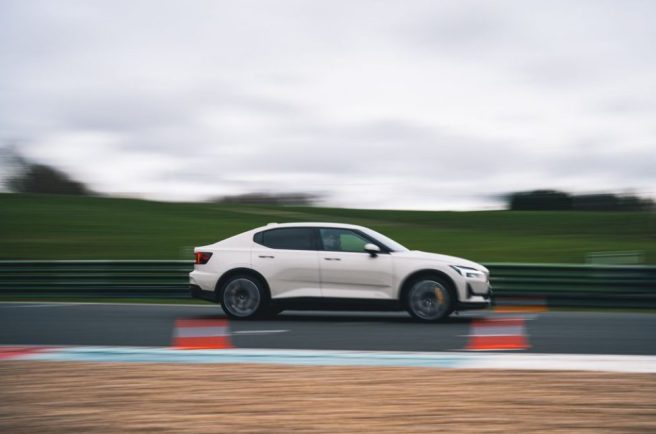
I was invited to visit Mallory Park racetrack to experience driving the Polestar 3 and 4, hosted by Paul Rigby Group.
Having never driven an electric car before I wasn’t sure what to expect. A lot of petrol heads say that driving a car without a ‘proper’ engine leaves behind an empty feeling.
Without that typical rumble of internal combustion, it can feel a bit like driving a laptop. But I think Polestar have created a range of cars that focus on performance, and still gives the driver a feeling of it having a personality.
Firstly, as with all electric cars the power is intense, sat in the driving seat and putting my foot to the floor the speed in which my head jerked back was insane.
That immediate level of power is something that took me while it get used to.
As well as the power, the car is clever, it has regenerative braking, a system that allows an EV to recover some of the energy that would otherwise be lost as heat during braking.
Traditional vehicles rely on friction brakes, which convert the kinetic energy of the car into heat, wasting all that potential power.
Regenerative braking, on the other hand, captures this kinetic energy and converts it back into electrical energy, which is then stored in the vehicle’s battery.
What all this means is, as soon as you take your foot off the accelerator to start braking, the car immediately slows down. Which is mostly terrifying, especially when you’re driving around a track.
It would take some getting used to, but you are able to change the sensitivity of it, and after a while it would become a normal part of driving.
Both the 3 and 4 drive beautifully, they are comfortable, with a fair amount of room. The 3 is your more traditional family SUV while the 4 is more of a coupe with better performance.
The Polestar 4 is also the first passenger car in the UK to remove the rear windscreen in favour of a digital rear-view mirror.
It does provide a much broader view to the rear of the car, but was off-putting to begin with. Again something I think you would get used to after a while.
Both models are really nice places to be, they’re high-tech without being too difficult to understand, and have a certain element of luxury you would expect from other traditional SUV’s like a Range Rover Evoque or BMW X5.
The 3 has a range of 348 to 438 miles depending on the powertrain and configuration, with the 4 going 310 to 340 miles between charges.
Overall for my first experience of electric cars I would say it was positive. You still retain the traditional sensation of driving, and for petrol heads I do think you would be able to bond with the car as you would any high-performance vehicle.
Would I have one? No.
Until the infrastructure is there to be able to fill your car with electricity as quickly as you can fill it with fuel it simply isn’t practical, and although they are exciting cars, I don’t think they excite me as much as my Range Rover.