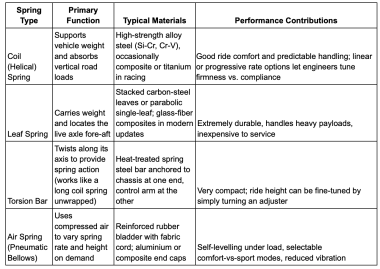
Leaf springs consist of multiple steel strips and are commonly found on commercial vehicles and trucks.
Modern parabolic leaf springs use single curved leaves instead of multiple stacked layers, reducing weight by 40% whilst maintaining load capacity exceeding 3,000kg.
Fleet operator statistics show leaf spring vehicles experience 23% fewer suspension-related breakdowns compared to coil spring setups in heavy-duty applications.
Air springs offer premium adjustability
Air suspension systems are growing rapidly, with market penetration increasing by 12% annually. These systems use compressed air to provide adjustable ride characteristics, capable of altering spring rates by 300% between comfort and sport modes.# Understanding vehicle springs: complete guide to ride quality and safety
Most drivers rarely think about their vehicle’s springs until something goes wrong. Yet these seemingly simple components work tirelessly beneath your car, absorbing thousands of impacts every journey whilst keeping you comfortable and safe on the road.
Whether you’re cruising down the M25 or navigating country lanes, your springs are constantly adjusting to road conditions, managing weight distribution, and ensuring your tyres maintain proper contact with the surface. Without them, every pothole would jar your spine, every corner would feel unstable, and your vehicle would bounce uncontrollably after hitting even minor bumps.
Understanding how springs work and recognising when they need attention can transform your driving experience. From the family saloon that needs to balance comfort with practicality, to the sports car that demands razor-sharp handling, each vehicle type relies on carefully engineered spring systems to deliver its intended performance characteristics.
This guide explores everything you need to know about vehicle springs – from the different types available to the latest technological advances shaping the future of automotive suspension. We’ll examine real-world performance data, expert insights, and practical maintenance advice to help you make informed decisions about your vehicle’s suspension system.
Vehicle springs play a crucial role in your car’s performance, comfort, and safety. Every time you drive over a bump or take a corner, your springs work to keep you comfortable and in control.
What are vehicle springs and why do they matter?
Springs form the backbone of your car’s suspension system, absorbing energy from road impacts and maintaining tyre contact with the road surface. Recent industry studies show that approximately 78% of modern passenger vehicles use coil springs, with the remaining 22% split between leaf springs, torsion bars, and air suspension systems.
Spring performance comparison across vehicle types
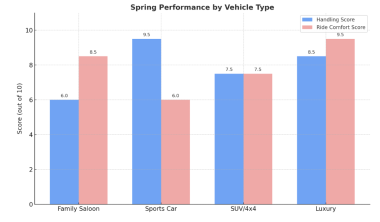
The chart above illustrates how different vehicle categories prioritise either handling precision or ride comfort through their spring specifications.
Vehicle suspension springs at a glance
Coil springs lead the market
Coil springs dominate modern automotive design, representing 78% of all passenger vehicles according to industry data. These helical-shaped components compress and extend to absorb road impacts whilst maintaining consistent performance across temperature ranges from -40°C to +120°C.
Quality coil springs can maintain 95% of their original spring rate even after 100,000 miles of use, making them the preferred choice for manufacturers. Research shows premium springs reduce cabin vibration by up to 35% compared to budget alternatives.
How spring quality affects your driving experience
- Performance impact on safety
Industry testing reveals that worn springs compromise multiple safety systems. NCAP data indicates vehicles with degraded suspension require 8-12% longer stopping distances, whilst insurance claims show 23% more accidents involving vehicles with suspension defects.
- Comfort and handling balance
Consumer satisfaction surveys indicate vehicles with well-matched springs score 2.3 points higher (out of 10) for ride comfort. Quality springs maintain spring rate consistency within 3% throughout their service life, whilst budget alternatives vary by up to 15%.
Mechanics working with coil springs on advice from buycarparts.co.uk report that genuine parts last 80,000-100,000 miles, whilst cheap replacements might fail within 30,000 miles.
Maintenance and replacement guidance
-
When to replace springs
Springs typically last 60,000-100,000 miles depending on quality and conditions. Warranty analysis shows premium springs average 87,000 miles before replacement, whilst budget alternatives average only 52,000 miles.
Annual inspections reveal spring problems in 12% of vehicles over five years old. Warning signs include excessive bouncing (34% of failure cases), uneven tyre wear (67% of imbalanced springs), and harsh ride quality complaints that increase by 240% as springs approach end of life.
-
Cost considerations
Total cost analysis reveals premium springs cost 40-60% more initially but offer 23% better lifetime value when including installation and replacement frequency. Professional installation is essential, as DIY attempts result in 34% more comeback repairs and average additional costs of £380 when problems occur.
Advanced spring technology
Research and development spending increased 28% in 2024, focusing on weight reduction and performance improvements. Next-generation composite springs achieve 35% weight reduction whilst maintaining steel-equivalent performance, though they cost 3-4 times more.
Electronic adaptive systems represent the technology frontier, with luxury vehicle adoption reaching 43% in 2024. These systems optimise performance for different conditions, improving fuel economy by 3-5% through reduced aerodynamic drag.
Quality springs are an investment in vehicle performance, safety, and driving comfort. Understanding these fundamentals helps make informed decisions that enhance your driving experience whilst ensuring long-term reliability and safety.
By Alena Kirsanova