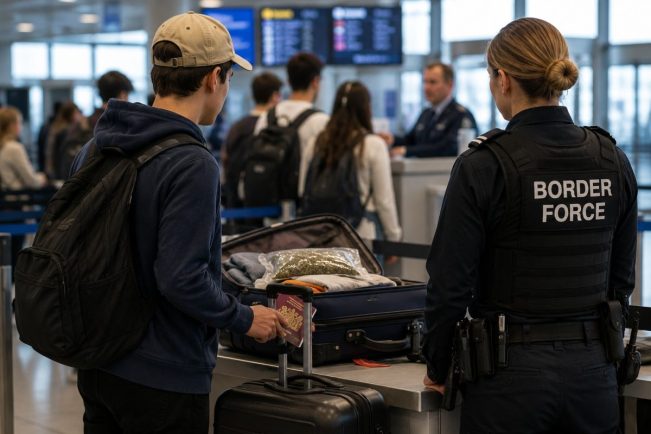
Officials are urging young Britons travelling abroad this summer to be on guard against criminal networks offering free trips in exchange for smuggling cannabis into the UK.
Border Force says gangs are increasingly using popular social media apps to build relationships with young people before persuading or pressuring them into acting as drug couriers, often disguising the arrangement as a generous gift of flights, luxury hotels and spending money.
The scale of the problem has grown sharply. Officers recorded just 142 cannabis smugglers arriving by air in 2023, a figure that climbed to 976 last year. In the first half of 2026 alone, 600 passengers were arrested at UK airports on suspicion of carrying cannabis, with young men travelling from Thailand forming the largest single group.
Recent graduates, first-time flyers and those offered suspiciously cheap holidays by new acquaintances are said to be particular targets, chosen because they are less likely to recognise the danger signs.
With the school and university holidays now under way, Border Force officers are stepping up efforts at airports to speak directly to travellers about the tactics used by traffickers.
Five warning signs to watch for
Border Force has issued the following guidance for anyone travelling this summer:
- Be wary of unusually generous offers. Free or heavily discounted flights, hotels and spending money, especially for trips to places where cannabis is legal such as Thailand, Canada and some US states, should raise immediate suspicion.
- Only carry your own luggage. Anyone who is asked to transport someone else’s bag, or told not to check its contents, should treat this as a serious red flag. Travellers can still be prosecuted even if they were unaware drugs were hidden in their belongings.
- Watch out for contact via social media. Platforms including TikTok, Snapchat and Instagram are commonly used by gangs to approach potential couriers. Officials advise blocking and reporting any such contact.
- Never hand over your passport. Requests to hold a traveller’s passport, sometimes framed as part of a booking arrangement, can be a means of exerting control, including using it to check in luggage without the traveller’s knowledge.
- Remember that legality abroad does not mean legality at home. Cannabis being legal in the destination country does not make it legal to bring into the UK, and attempting to do so remains a serious criminal offence.
Consequences can last a lifetime
Kate Goldstone, Border Force’s lead officer for safeguarding, said criminal gangs profit from exploiting young people while leaving them to bear the consequences alone. She said the guiding principle for travellers should be that offers which seem too good to be true usually are, and warned that a single poor decision before a trip can result in a criminal record, a prison term and years of missed opportunities.
Those convicted of smuggling cannabis face up to 14 years in prison, a criminal record and travel restrictions that can affect future job prospects and education, regardless of how they came to be involved.
Seizures reflect the growing scale of the trade: Border Force recovered 2.1 tonnes of cannabis from air passengers in 2022, a figure that has since risen to more than 28 tonnes in 2025, an increase of 50% in the past year alone.
While Thailand remains a particular concern, authorities note that criminal networks can operate in any country where cannabis is legal or easily obtained, including parts of Europe, Canada and the United States.
The warning coincides with a new joint crackdown between the UK and Thailand, under which British nationals caught trying to smuggle cannabis out of the country face average fines of about £17,700 or a prison sentence of up to two years.
Anyone who is approached and asked to carry cannabis or other illegal drugs is encouraged to report it to local police, consular officials, or Crimestoppers on 0800 555 111.
Main Image: For illustration purposes only.