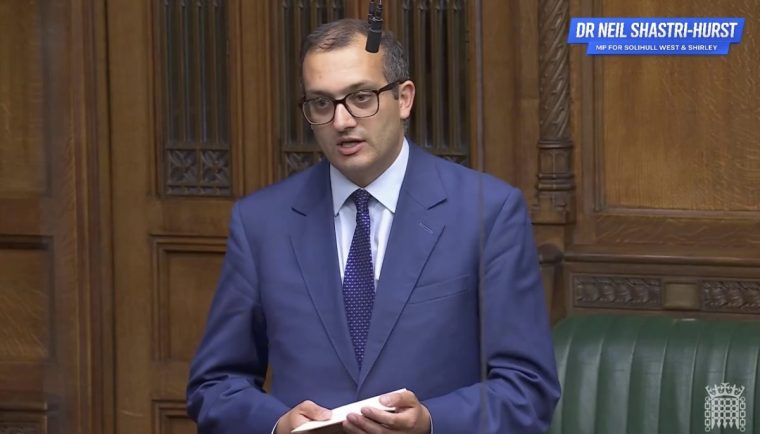
Dr Neil Shastri-Hurst MP has warned that Britain must move faster to prepare for the threats it faces, telling the House of Commons that the country cannot afford to treat rearmament as something for the next decade.
Speaking during a Commons debate on rearmament and warfighting readiness, the Solihull MP said politicians owed the public “searing honesty” about the deteriorating security situation, rather than reassurance.
Referring to his register of interests, including a parliamentary delegation to Ukraine earlier this year with the UK Friends of the Armed Forces, Dr Shastri-Hurst told MPs the debate had shown broad agreement in the chamber about the seriousness of the moment, but said that recognition needed to be matched by honesty with the wider public.
He noted that the Government has said Russia could be capable of attacking a NATO ally by the end of the decade, and pointed to warnings from the Chief of the Defence Staff and from Lord Robertson, the former NATO Secretary General, that the UK is “simply not ready.”
“We must not treat the British public like children,” he said. “They do not need comforting slogans. They need searing honesty from people in public office.”
He argued it was inconsistent to warn of hostile states probing UK waters, energy networks, satellites and cyber systems, while offering solutions that would not be delivered for years to come.
“We cannot describe a 2030 threat and offer a 2035 solution,” he told MPs, adding that this was “the central weakness at the heart of the government’s approach to date.”
Dr Shastri-Hurst said readiness depended on more than equipment, pointing to the need for trained personnel, stockpiles, reservists able to mobilise, factories capable of surging production, and ports and energy systems able to cope with increased demand.
“A nation is ready when the whole system is ready to row behind it,” he said.
He also repeated his backing for raising defence spending to 3 per cent of GDP within this Parliament, calling it “the bare minimum” given the deteriorating global picture, rather than an “extravagant ambition.”
Reflecting on three decades of relative peace since the end of the Cold War, he said Britain had too often behaved “as though this would never end,” warning that “freedom is never free.”
“Our duty is to ensure that this generation pays in preparedness, so that the next generation doesn’t pay in blood,” he said.
Dr Shastri-Hurst closed his speech by insisting Britain retained significant strengths, including its armed forces, intelligence services and scientific and engineering expertise, and that the public had “never failed this country when they’ve been told the truth.”
“The cost of preparedness will always be far less than the cost of war itself,” he concluded.