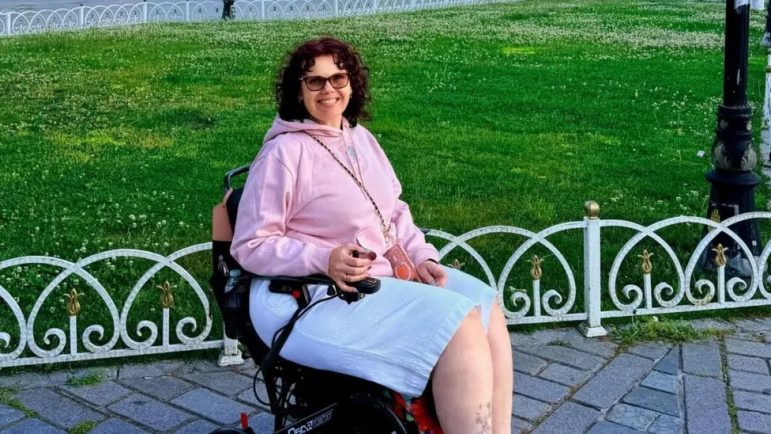
A Solihull mother whose inspiring journey with a debilitating neurological condition has attracted national attention, including coverage by the BBC, is determined to prove that life can still be full of adventure, family memories and success despite significant health challenges.
Sarah Lewis was diagnosed with Functional Neurological Disorder (FND) in 2023 after experiencing a series of alarming symptoms that rapidly transformed her daily life.
The mum of two initially dismissed frequent migraines and episodes of choking while eating, believing they were simply the result of exhaustion or eating too quickly. However, her health soon deteriorated.
Within weeks, Sarah developed a persistent headache, struggled to walk in a straight line, experienced pins and needles down one side of her body and began suffering tremors in her hands.
The condition eventually affected her speech and mobility, leaving her unable to walk without assistance.
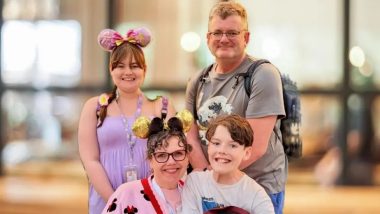
Sarah Lewis and her family enjoyed a trip to Disneyland ((Photo: Sarah Lewis).
Speaking to the BBC, Sarah said: “It’s been the steepest of learning curves. The things that you have to consider that wouldn’t enter your head, just daily challenges.”
Now aged 46, Sarah uses a wheelchair but has refused to let her diagnosis stop her from embracing life.
Three years after being diagnosed, she has launched her own cake business, Cakey Blinders, combining a lifelong passion for baking with a determination to remain positive and active.
“I was so focused on trying to find a cure, I was driving myself crazy and I realised I wasn’t living properly,” she said.
Sarah started the business in October 2025 as a practical way of teaching her home educated 11 year old son about marketing and entrepreneurship.
The venture has become a true family effort. Relatives assist with everything from removing cakes from the oven and serving customers at markets, to taking photographs for social media.
“Baking is my therapy, everything switches off and it’s just me and the cake,” she said.
She added that being involved in customers’ special celebrations is one of the most rewarding aspects of the business.
Despite the limitations imposed by her condition, Sarah and her family have continued to make memories together, travelling to destinations including Egypt, Disneyland Paris and Istanbul, where she and her husband attended the UEFA Europa League final. The pair are Aston Villa season ticket holders.
Sarah believes maintaining a positive outlook has been essential.
“I just think if I wasn’t upbeat I wouldn’t do anything, as everything is so challenging and fatigue is one of the most limiting aspects,” she said.
She admits there was a time when leaving the house felt frightening, but says she has learned to focus on resilience.
“Ultimately it’s brought {our family} closer together, as it’s made us realise how much we love each other. We really cherish the time we get together,” she said.
Sarah is also determined that her children continue to enjoy life and create lasting memories despite the family’s changed circumstances.
She said she was “determined” to let her children have the “best memories”, even though they could no longer do all the things they once enjoyed.
What Is Functional Neurological Disorder?
Functional Neurological Disorder, commonly known as FND, is a condition that affects how the brain and nervous system function. Although the nervous system itself may appear structurally normal on scans and tests, communication between the brain and body does not work correctly.
Symptoms can vary widely and may include weakness, tremors, seizures, speech difficulties, sensory changes, chronic pain, fatigue, dizziness and problems with movement or balance.
According to the NHS, symptoms can be short lived for some people but may persist for months or years in others, significantly affecting day to day life.
Treatment can involve physiotherapy, occupational therapy, psychological therapies and specialist rehabilitation programmes. While some people make a full recovery, others continue to experience symptoms long term, although gradual improvement is often possible with the right support and treatment.
Sarah’s story has resonated with many people living with long term health conditions, offering a powerful reminder that although life may change dramatically after diagnosis, it is still possible to find purpose, joy and new opportunities.