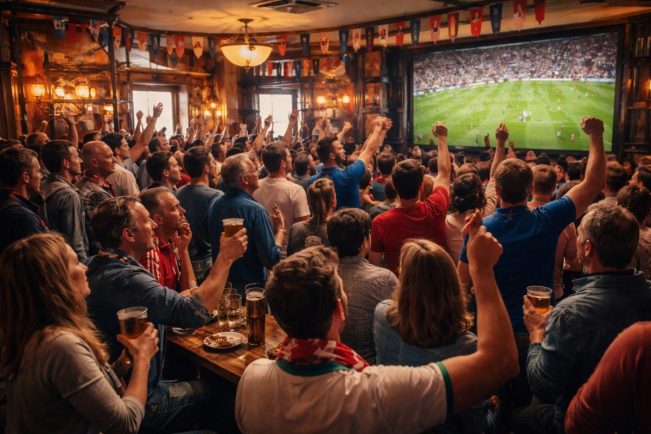
Sport changes how people occupy shared space. On ordinary days, pubs, community halls, and living rooms follow predictable routines.
On match days, those routines tighten. Attention aligns.
Time compresses. Decisions become collective rather than individual. These moments do not feel exceptional because of spectacle alone. They feel familiar because they repeat, season after season, inside the same streets and social circles.
Local sports watching rituals persist because they reduce friction. They give people a reason to show up without negotiation. No invitation feels intrusive. No explanation feels required. The event itself provides permission. That simplicity matters in communities where time feels scarce and social energy unevenly distributed.
Why Communal Viewing Still Works
Shared viewing survives digital convenience because it solves a social problem screens cannot, reinforcing established public viewing habits built around presence, reaction, and shared time.
These environments favour participation over expertise. Not everyone understands tactics. Not everyone follows the season closely. That does not matter. What matters is alignment. A goal, a missed chance, or a disputed decision triggers the same response across the room. The ritual holds even when knowledge varies.
Local communities rely on this structure. It allows different ages, backgrounds, and levels of interest to occupy the same space without tension. Sport becomes a shared language rather than a test of competence.
The Role of the Local Pub
Pubs anchor these rituals because they absorb pressure well. They handle crowd density, emotional swings, and extended attention better than private spaces. During major fixtures, the pub stops operating as a service venue and starts operating as one of the social public spaces that absorb collective attention and emotional pressure.
Regulars expect this shift. Screens multiply. Seating rearranges. Conversations are narrow. Staff anticipate surges rather than react to them. These adjustments feel routine because they repeat across seasons and tournaments.
The pub does not explain the game. It hosts it. That distinction keeps the atmosphere stable even when stakes rise. People understand the behavioural code without instruction. Watch. React. Stay. Return next time.
Informal Prediction and Collective Risk
Midway through these gatherings, behaviour changes subtly. Attention turns from observation to anticipation. People compare expectations. They signal confidence or doubt. This is where informal prediction enters the ritual.
In many groups, light engagement with online betting becomes part of that rhythm, not as a focal activity but as a shared reference point. A price shift or late change provides a talking point rather than a directive. The wager itself matters less than the collective moment of decision it creates.
This behaviour mirrors how communities already process uncertainty. People test judgment socially. They absorb risk together. Success and failure remain visible, which limits escalation and keeps participation grounded.
Community Centres and Public Screens
Outside pubs, community centres and temporary public screenings perform a similar function with different constraints. These spaces attract broader demographics. Families, older residents, and people who avoid pub culture still want access to the same shared moments.
Public screens succeed when they impose structure without formality. Clear start times. Defined viewing areas. Minimal programming beyond the match itself. When organisers add too much framing, engagement drops. The ritual works best when the event speaks for itself.
These gatherings matter because they include people who might otherwise remain peripheral. Sport becomes a point of entry rather than a divider. The emphasis stays on presence, not performance.
Local Clubs as Social Infrastructure
Amateur and semi-professional clubs operate as social infrastructure, providing continuity between major televised events and everyday community life. Clubhouses double as viewing spaces. Matches become extensions of local identity rather than isolated fixtures.
These environments blur roles. Players watch alongside supporters. Volunteers discuss decisions they influenced directly. The separation between spectator and participant weakens. That proximity strengthens attachment.
Financial pressures exist, but the ritual itself often sustains engagement. People return because the space feels familiar, not because outcomes improve. Stability matters more than success.
Digital Layers Without Replacement
Digital platforms now extend these rituals without replacing them. Group chats activate before matches. Commentary continues after the final whistle. Decisions get revisited and reframed.
These channels work because they attach to physical experiences rather than compete with them, reflecting patterns of hybrid social interaction rather than digital replacement. Where digital-only communities struggle with churn, hybrid rituals persist. People know where and when they belong offline. Online discussion reinforces that knowledge.
The mistake comes when digital interaction attempts to stand alone. Without shared physical moments, attention fragments and commitment weakens.
Limits and Trade-offs
These rituals carry constraints. Not everyone feels welcome in every space, a reality shaped by social participation barriers rather than lack of interest. Noise excludes some. Alcohol-centred environments limit others. Time-bound events can alienate shift workers or carers.
Communities manage these limits through variety rather than optimisation. Multiple venues. Different formats. Seasonal changes. No single solution serves all groups, and attempts to standardise usually fail.
What sustains these rituals is acceptance of imperfection. People choose participation knowing conditions are not ideal. The alternative feels worse.
Why These Rituals Persist
Local sports watching rituals endure because they answer a basic need without demanding explanation. They offer structure, shared risk, and visible belonging. They operate on repetition rather than novelty.
In an environment where attention fragments easily, these moments still pull people into the same room at the same time. That alignment carries value beyond the match itself.
Communities do not preserve these rituals out of nostalgia. They keep them because they work.