THOUSANDS of families faced with a potential health hazard from living in mouldy homes are breathing easier following a £15m programme to upgrade some of the region’s dampest social housing.
The money, given to local councils by the West Midlands Combined Authority (WMCA), has been used to install damp busting measures in more than 4,400 homes across the region.
Around 8,000 individual improvements have been carried out with some homes also getting new insulation and heating systems.
A number of leaky roofs, windows and doors have also been fixed.
The Social Housing Decency Fund programme is now nearing completion ahead of the Government’s introduction of Awaab’s Law in October – this will require social housing landlords to investigate and fix black mould and damp within strict timelines.
The new law is named after three-year-old Awaab Ishak who died from mould exposure in his Rochdale home in 2020.
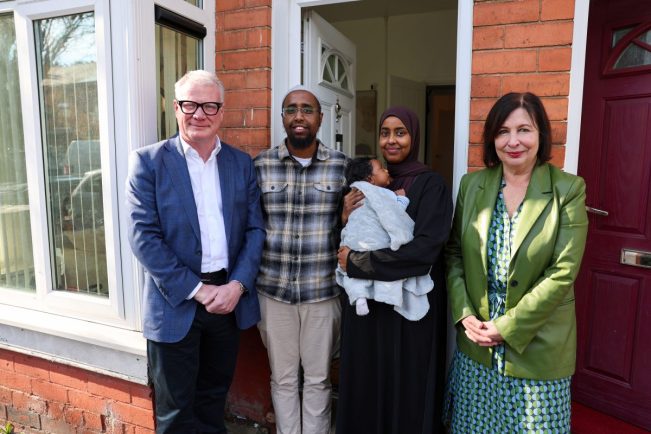
Ruqia Ali and her two-month-old baby boy Zakariya are among the 10,000 people to benefit from the programme.
She lives with husband Abdikadir and their two other children, six-year-old son Zayd and daughter Sara, aged three, in a council house in Bordesley Green.
The family had several measures installed at their Victorian-built, two up, two down terraced house including roof space ventilation and specialist kitchen and bathroom fans.
Ruqia said: “The condensation in the house was really bad before. It was aggravating my asthma and making me feel worse. We had damp on the walls and mould coming up from the skirting boards in the bedrooms.
“But we’ve had no damp since the work was done and the house is now really comfortable. I feel much better and I don’t have to worry any more about how it’s affecting our health. It’s made a big difference.”
Richard Parker, Mayor of the West Midlands, joined Councillor Jayne Francis, Birmingham City Council’s cabinet member for housing and homelessness, to see how the work has made Ruqia’s home safer and healthier.
The Mayor said: “It can’t be right that in 2025, in one of the world’s richest countries, there are thousands of children living in cold, damp and mouldy homes.”
According to the most recent English Housing Survey it is thought there are as many as 90,000 homes in the West Midlands that fail to meet decency standards.
Around 60,000 of these are privately rented and 30,000 are social homes for rent, owned by councils or housing associations.
The survey estimated that the investment required to make all of these properties decent would be around £600m.
The Social Housing Decency Fund improvements on Mrs Ali’s home were carried out alongside wider work being done by Birmingham City Council which is investing £1.6bn into its council houses over the next seven years.
The council’s investment program began in April 2024 and just over £240m was invested last year, with a similar amount set to be invested again this year.
Last year the WMCA commissioned the housing research team at the Centre for the New Midlands to undertake a wide-ranging evaluation of the problem of damp.
It found that many tenants still faced life-threatening health risks from long-term exposure to dangerous levels of damp and mould and that it was commonplace for tenants to live with the hazard for four years or more.
Consequently, many tenants reported feelings of helplessness and a range of mental and physical health issues.
The report consequently called for a new funding model for social and council housing so damp and mould issues could be better tackled.